Last Updated: November 15, 2026
Quick Summary
To read skincare ingredient labels, scan the list in descending order of concentration until you reach the unmarked 1% threshold, then treat everything after it as trace. Learn INCI names so you can identify actives, preservatives, fragrance and allergens, and ignore front-label marketing claims.
- Ingredients appear in descending order of concentration until the list reaches the 1% mark.
- Preservatives such as phenoxyethanol typically sit at 0.1-1%, so anything after them is almost certainly sub-1%.
- INCI stands for International Nomenclature of Cosmetic Ingredients, a standardized naming system for comparing brands.
- Fragrance and parfum are the single most common cause of contact reactions on ingredient lists.
- Patch test behind the ear or inner forearm and wait 24 to 48 hours before using a product on your face.
Can you read a skincare label yet?Shop MoH-licensed skincare with clear ingredient lists and flat AED 15 delivery.
Table of Contents
- Why Skincare Ingredient Labels Matter More Than Marketing Claims
- The Rule of Descending Order: What Comes First Matters Most
- Understanding INCI Names on Skincare Labels
- How to Tell Active Ingredients from Inactive Fillers
- The 1% Threshold and What It Means for Product Efficacy
- Common Skincare Allergens to Avoid on Ingredient Lists
- How to Check Skincare Product Expiry Dates and Shelf Life
- Dermatologist Recommended Products for Acne: Reading Labels Before You Buy
- Greenwashing vs. Science: Decoding Marketing Claims on Labels
- Shop Saha Jamal for MoH-Licensed Skincare You Can Trust
- Frequently Asked Questions
Why Skincare Ingredient Labels Matter More Than Marketing Claims
Most skincare shoppers read the front of the bottle. The real story is on the back. Learning how to read skincare ingredient labels is the single most useful skill you can build for your skin, because it lets you judge a formula on what it actually contains rather than what the marketing promises.
Marketing copy is written to sell. The ingredient list is regulated, ordered, and harder to dress up. That gap is where most buying mistakes happen.
Below, we walk through the full decoding process: the descending order rule, INCI naming, the 1% threshold, allergens, expiry dates, and the greenwashing tricks that catch even careful buyers. The payoff is simple. You stop paying for perfume and start paying for actives.
The Rule of Descending Order: What Comes First Matters Most
Ingredients appear in descending order of concentration until the list reaches the 1% mark. That single rule tells you more about a product than any front-label claim. If a “miracle” serum lists its star botanical after the fragrance, that botanical is present in a trace amount.
Here is how to use the order in practice:
- First five ingredients: these make up the bulk of the formula. Water, glycerin, and alcohols usually sit here.
- Middle section: the supporting cast, including emollients, emulsifiers, and preservatives.
- After the 1% point: actives, extracts, and colourants, often at levels too low to do much.
A common mistake is assuming a long, exotic ingredient list means a sophisticated formula. Often it means a lot of decoration after the 1% line. The shorter and more purposeful the list, the easier it is to judge.
Understanding INCI Names on Skincare Labels
INCI stands for International Nomenclature of Cosmetic Ingredients, a standardized naming system that lets you compare the same ingredient across different brands and markets. It is the reason you see “aqua” instead of water and “tocopherol” instead of vitamin E. The system is not arbitrary: it follows a set of naming conventions that, once you learn them, let you decode almost any label without a glossary.
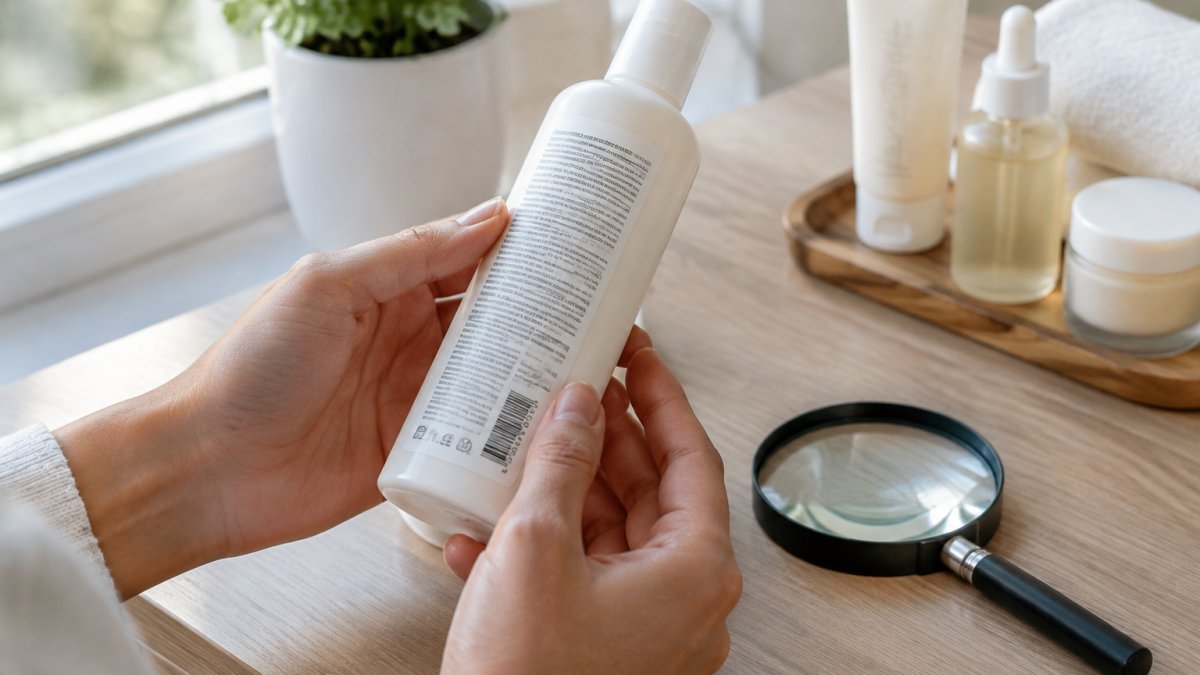
The system mixes Latin, English, and chemical names, which is why labels look intimidating. Four naming conventions cover most of what you will see:
- Latin binomials for botanicals. Plants are listed by genus and species, not by marketing name. Butyrospermum parkii is shea butter. Rosa canina is rosehip. Aloe barbadensis is aloe vera. If a brand wants to sound exotic, it can print “shea” on the front and list Butyrospermum parkii on the back, same ingredient, two languages.
- Chemical names for synthetics. Glycerin, niacinamide, salicylic acid, and sodium hyaluronate are the INCI names, not brand inventions. A brand cannot rename them to sound gentler.
- CI numbers for colourants. Colour additives appear as “CI” followed by a five-digit number (CI 77891 is titanium dioxide, CI 19140 is tartrazine yellow). These are the only ingredients regulators require to be identified by a numeric code rather than a name.
- Parenthetical common names. Many labels add the familiar name in brackets after the INCI term, “Aqua (Water), Glycerin, Tocopherol (Vitamin E)”, which is a courtesy, not a requirement. Its presence usually signals a brand that expects informed shoppers.
A few translations cover most of what you will see in daily use:
- Aqua: water, usually the base of the formula
- Glycerin: a humectant that draws moisture into the skin
- Tocopherol: vitamin E, an antioxidant
- Niacinamide: vitamin B3, used for tone and oil control
- Salicylic acid: a beta hydroxy acid used for blemishes
- Sodium hyaluronate: the salt form of hyaluronic acid, the version most formulas actually use
- Phenoxyethanol: a common preservative, usually near the end of the list
Understanding INCI names on skincare labels is mostly a matter of learning twenty or so common entries plus the four conventions above. Once you recognize them, the list stops being a wall of Latin and becomes a recipe you can read, and, crucially, a document you can compare across two products side by side. Two serums that both claim “vitamin C” may list ascorbic acid, sodium ascorbyl phosphate, or ascorbyl glucoside; those are three different molecules with different stability and penetration profiles, and the INCI list is the only place the difference is disclosed.
Watch out: a brand that lists a botanical by its marketing name on the front and its Latin binomial on the back is not being deceptive, but it is making you do the translation work. Treat the back label as the authoritative version and the front as advertising.
For a deeper walkthrough of what each entry means and how licensing and labelling connect, our guide on how to verify MoH licensed skincare explains the regulatory side.
How to Tell Active Ingredients from Inactive Fillers
Active ingredients are the components that change your skin; inactive ingredients are the vehicle that carries them. Both matter. A brilliant active in a poorly built base can still irritate or fail to absorb.
Actives you will recognize by name: retinoids, vitamin C (ascorbic acid), niacinamide, salicylic acid, glycolic acid, azelaic acid, and benzoyl peroxide. Everything else, including water, glycerin, silicones, and preservatives, exists to deliver, stabilize, or preserve those actives.
What most guides miss is that the base is not filler in any meaningful sense. Humectants pull in water, emollients soften, emulsifiers hold oil and water together, and preservatives keep the product safe. A formula with a weak base and a strong active often underperforms a balanced one.
If you want to see how a well-labelled product lists its actives clearly, this anti-blemish serum is a useful reference point for reading a real formula.
The 1% Threshold and What It Means for Product Efficacy
The 1% threshold is the point on the ingredient list below which brands no longer have to disclose exact concentrations. Everything after it can appear in any order, which is why the second half of a label tells you far less than the first. The rule exists because regulators recognized that most formulas contain dozens of ingredients at fractions of a percent, and forcing exact disclosure of every trace component would be impractical and would expose proprietary ratios. The trade-off is that the back half of the list becomes a zone of ambiguity that brands can exploit.
This matters for product efficacy. A brand can list a celebrated active near the bottom and still print it on the front in large letters. The active is there, but at a concentration that may do very little.
The practical problem is that the 1% line is not marked. You have to infer it. Three signals help you locate it:
- Preservatives are almost always below 1%. Phenoxyethanol, sodium benzoate, potassium sorbate, and methylparaben are typically used at 0.1-1%. If you see a preservative, everything after it is almost certainly sub-1%, and often so is the preservative itself.
- Fragrance is usually below 1%. Parfum and individual fragrance allergens (limonene, linalool, citronellol) sit near the bottom. If your active appears after the fragrance, the fragrance is the larger component.
- Colourants (CI numbers) and chelators (disodium EDTA) are trace. They cluster at the very end and confirm you are deep in the sub-1% zone.
Three practical checks follow from this:
- If the active you want sits after the preservatives, treat the front-label claim with caution.
- If the formula lists fragrance before your active, the fragrance is likely the larger component.
- If the brand publishes a percentage on the front, check that the same active appears early in the list. A “10% niacinamide” claim should place niacinamide in the top five; if it appears after the preservatives, the number is doing marketing work, not formulation work.
None of this means low concentrations are useless. The point is to read the order honestly rather than assume the front label reflects the formula. A well-built formula often places its actives deliberately, sometimes below 1% because that is the clinically appropriate dose, sometimes high in the list because the product is built around them. The label tells you which, if you know where the line falls.
Watch out: “water-free” and “concentrated” claims often push water down the list so that actives appear higher by default. Read the first five ingredients as a set, not as a ranking of importance.
Three signals help you locate the unmarked 1% line on an ingredient list.
| Signal | Typical level | What it tells you |
|---|---|---|
| Preservatives (phenoxyethanol, sodium benzoate, potassium sorbate, methylparaben) | 0.1-1% | Everything after them is almost certainly sub-1% |
| Fragrance (parfum, limonene, linalool, citronellol) | Usually below 1% | An active listed after fragrance is the smaller component |
| Colourants (CI numbers) and chelators (disodium EDTA) | Trace | Cluster at the very end, deep in the sub-1% zone |
Common Skincare Allergens to Avoid on Ingredient Lists
Fragrance and preservatives are common sources of cosmetic reactions, and both are easy to spot once you know the names. If your skin stings, reddens, or breaks out after a new product, the allergen is usually in the last third of the list.
Watch for these common skincare allergens to avoid:
- Fragrance and parfum: the single most common cause of contact reactions
- Essential oils: lavender, citrus, peppermint, and tea tree are frequent culprits
- Preservatives: methylisothiazolinone, formaldehyde releasers, and some parabens
- Lanolin and wool alcohols: problematic for some sensitive skins
- Sulfates: harsh surfactants that strip the skin barrier in cleansers
If you are prone to irritation, patch testing is non-negotiable. Apply a small amount behind the ear or on the inner forearm, wait 24 to 48 hours, and watch for a reaction before using it on your face.
For anyone managing breakouts alongside sensitivity, a targeted treatment with a clearly stated single active, such as this salicylic acid spot patch, is often easier to tolerate than a multi-ingredient formula. If you are building a routine around blemishes, our roundup of dermatologist recommended products for acne pairs well with label reading.
How to Check Skincare Product Expiry Dates and Shelf Life
Expiry dates tell you when an unopened product stops being reliable; the period-after-opening symbol tells you how long it stays usable once opened. Both matter, and most shoppers check neither.
Here is the routine we suggest:
- Look for the date stamp: most products carry a best-before date on the base or crimp of the tube.
- Find the open-jar symbol: a small jar icon with “6M” or “12M” means six or twelve months after opening.
- Write the opening date on the bottle with a marker so you stop guessing.
- Store it properly: heat and direct sunlight break down actives faster than time alone.
A vitamin C serum that has turned brown, or a sunscreen that has separated, may have degraded regardless of the printed date. If the texture, smell, or colour has changed, replace it.
Dermatologist Recommended Products for Acne: Reading Labels Before You Buy
Learn to spot that pattern, and you can evaluate any acne product on the shelf.
On the label, these should appear before the preservatives if the product is serious about them.
Two label habits make the biggest difference for acne-prone skin:
- Check for non-comedogenic claims and confirm the formula avoids heavy oils near the top of the list.
- Look for fragrance-free, since fragrance adds irritation risk without any acne benefit.
A common mistake is layering three actives at once and wondering why the skin rebels. Start with one, give it several weeks, and add a second only if the skin tolerates the first. If you want a starting point, our acne product guide covers the options we see customers return to most often.
Greenwashing vs. Science: Decoding Marketing Claims on Labels
Greenwashing is the practice of using natural-sounding language to imply safety or efficacy that the formula does not support. “Chemical-free” is the clearest example: water is a chemical, so the claim is meaningless. “Clean beauty” has no agreed definition and is largely a marketing term.
Here is how to separate the science from the spin:
- “Natural” does not mean safer. Poison ivy is natural. Many natural essential oils are among the most irritating ingredients in cosmetics.
- “Dermatologist-tested” is not the same as dermatologist-recommended. The first means a test happened; the second means a professional endorses it.
- “Hypoallergenic” is unregulated in most markets. Treat it as a marketing signal, not a guarantee.
- “Free from” claims are selective. A product can be paraben-free and still contain other preservatives you react to.
The reliable move is to ignore the front label entirely and read the INCI list. If a brand is confident in its formula, the ingredient list will back up the claim. If it will not, that tells you something too.
For parents weighing gentler formulas, our guide on how to choose baby skincare products applies the same label-reading logic to sensitive skin.
Shop Saha Jamal for MoH-Licensed Skincare You Can Trust
Reading labels protects you from bad formulas, but it cannot confirm that a product is genuine, stored correctly, and legally sold. That is where the source matters as much as the ingredients.
Saha Jamal is a MoH-licensed online platform, and we have spent over three decades in the Middle Eastern beauty and healthcare industry. Every order ships with a flat AED 15 charge across the country, with estimated delivery in 2-3 working days. Payments are 100% secured, and our returns policy is flexible.
Bring your label-reading skills to a catalogue you can trust. Get started with Saha Jamal and shop MoH-licensed skincare with confidence.
If you have ever bought a product that promised everything and delivered nothing, the fix is not a new brand, it is a new habit: read the back of the bottle first. Saha Jamal stocks MoH-licensed skincare, haircare, and wellness products with clear labelling, flat AED 15 delivery, and secure checkout. Get started with Saha Jamal and build a routine you can actually verify.
Frequently Asked Questions
What is the order of ingredients on a skincare label?
Ingredients are listed in descending order of concentration, meaning the ingredient with the highest amount appears first and the one with the least amount appears last. Ingredients present at 1% or less can be listed in any order after the first few. This is why water (aqua) often appears first in many formulations. Pay attention to where active ingredients fall in the list to gauge their relative strength.
Are there specific ingredients I should avoid in my skincare?
Yes, common skincare allergens to avoid include fragrances, parabens, sulfates, phthalates, and certain preservatives like methylisothiazolinone. If you have sensitive skin, look for fragrance-free and non-comedogenic labels. Always patch test new products on a small area of skin before full application. For personalized advice, consult a dermatologist who can help identify your specific triggers.
How can I tell if a product is MoH-licensed?
In the UAE, MoH-licensed products carry a registration number on the packaging, often starting with ‘MOH’ followed by digits. You can verify the license by checking the Ministry of Health and Prevention’s official website or by contacting the retailer. Saha Jamal is a MoH-licensed website (License No: HAVU1MDZ-110326), so you can shop with confidence in its licensing status.
What does ‘fragrance-free’ really mean on a label?
Fragrance-free means the product contains no added fragrance or perfume, making it suitable for sensitive skin. However, some products labeled ‘unscented’ may contain masking fragrances to cover the smell of raw ingredients. Always check the INCI list for terms like ‘parfum’ or ‘fragrance’ to be sure. If you have allergies, look for products that are explicitly fragrance-free and hypoallergenic.
How do I identify active ingredients versus inactive ingredients?
Active ingredients are the components that deliver the product’s primary benefit, such as salicylic acid for acne or hyaluronic acid for hydration. They are often listed after the first few ingredients and may be highlighted on the packaging. Inactive ingredients include fillers, preservatives, emulsifiers, and fragrances that support the formula’s texture and stability. Understanding INCI names helps you spot actives like retinoids, vitamin C, and niacinamide.
Why are some ingredient names written in Latin?
Latin names are used in INCI (International Nomenclature of Cosmetic Ingredients) to provide a universal standard that avoids translation confusion across countries. For example, ‘aqua’ means water and ‘tocopherol’ means vitamin E. This standardization helps consumers and professionals identify ingredients consistently, regardless of the product’s origin. Familiarizing yourself with common Latin terms makes reading labels much easier.