Last Updated: October 31, 2026
Quick Summary
To verify MOH licensed skincare, search the product’s registration or notification number on the MOHAP cosmetics portal, not the product name. Then confirm the returned record’s status is active and its details match your pack exactly. A returned record alone is not a green light; the status and expiry date decide that.
- Practitioner licenses cover people; product registrations cover what is allowed on the shelf.
- Search the unique registration number, since name searches return every similarly named product.
- A record can return as active, expired, suspended, or cancelled, and only active is in force.
- A 30ml registration does not cover a 50ml bottle, so compare pack size and variant.
- A screenshot of a license is not verification; confirm the record on the official portal.
Table of Contents
- Two Different Credentials: Practitioner Licenses vs Product Registrations
- Step 1: Confirm the Regulatory Authority and Jurisdiction
- Step 2: Run a MOHAP Registered Cosmetics Search and Verify the Skincare Product Registration Number
- Step 3: Verify the Skincare Product Registration Number Against the Label
- Step 4: Check Cosmetic Product Label Requirements UAE Rules Set Out
- Step 5: Verify the Practitioner or Business Behind the Product
- Frequently Asked Questions
Two Different Credentials: Practitioner Licenses vs Product Registrations
Knowing how to verify MOH licensed skincare starts with one question most buyers never ask: which MOH licensed skincare credential are you checking? A practitioner holds a professional license to treat patients; a cosmetic product holds a registration or notification allowing it to be sold.
A common pattern is a shopper who checks a clinic’s license and assumes the serum on the shelf is cleared, or finds a product registration and assumes the adviser is qualified.
Why the distinction decides where you search
A professional license confirms a person, clinic, or facility is authorized to practice. A product registration confirms a cosmetic item has been filed with the regulator and can legally be sold. One covers people.
- Practitioner license: who is allowed to treat or advise you
- Product registration: what is allowed on the shelf
- Facility authorization: where a service can legally be delivered
Checking a product mirrors checking a pharmacy product. For the parallel walkthrough, our guide on how to verify MoH licensed pharmacy products applies the same steps to medicines.
Step 1: Confirm the Regulatory Authority and Jurisdiction
Start by confirming which body regulates the item in front of you.
MOHAP is the federal body responsible for registering cosmetics and licensing health professionals. Its official portal is where verification happens. MOHAP official website hosts the registration and licensing services you will use.
- Is this a person or a product? That decides the database.
- Is the item a cosmetic, a medical device, or a medicine? Each has its own route.
A common mistake is searching a product name in a practitioner database; nothing matches, and people wrongly conclude the product is fake.
Step 2: Run a MOHAP Registered Cosmetics Search and Verify the Skincare Product Registration Number
The fastest path is a MOHAP registered cosmetics search using the registration or notification number printed on the packaging, the product’s official identity and the single most reliable thing to check. The search only works if you know which field you are searching and how to read the result.
Where to search on the MOHAP portal
MOHAP runs separate service lanes for cosmetics registration, health professional licensing, and facility licensing. The cosmetics lane is the one you want for a product. Consult the official MOHAP portal for the current cosmetics registration search and verification options before relying on any specific menu path.
MOHAP e-services portal
Which number you are actually holding
Not every number on a pack is a registration number. Distinguish these first:
- Registration number, issued when a cosmetic product is registered with MOHAP; typically the strongest record.
- Notification number, issued for products filed under the notification route; confirms the file exists but is not the same as a full registration.
- Batch or lot code, a manufacturing identifier, not a regulatory number. Searching it will return nothing.
If the pack shows only a batch code and no registration or notification number, treat that as a labelling gap and move to the label check in Step 4.
The search, field by field
- Locate the registration or notification number on the pack, usually on the back or base label, near the manufacturer details.
- Open the MOHAP cosmetics search and select the correct identifier type (registration vs notification).
- Enter the number exactly as printed, including hyphens and prefixes.
- Read the returned record: product name, brand owner, manufacturer, country of manufacture, pack size, registration status, and expiry date.
- Compare each field to the pack in your hand, not just the product name.
Pro Tip
Search the number, not the product name. Name searches return every similarly named product and make a mismatch hard to spot. The number is unique; the name is not.
Search the number, not the product name. Name searches return every similarly named product and make a mismatch hard to spot. The number is unique; the name is not.
Reading the status field
The status field is where most buyers stop reading too early. A record can return as active, expired, suspended, or cancelled. Active means the registration is in force on the date you checked; expired means it lapsed and the product should not be on sale as a registered item; suspended or cancelled means the regulator has taken action. A returned record is not automatically a green light, the status and expiry date decide that.
What to do when the registration number returns no result
No result is not proof of a fake. It usually means one of five things: the number was mistyped, the product was never registered, the registration lapsed and was removed from public view, you searched the wrong lane, or the product is regulated under a different category such as a medical device.
Not every number printed on a pack is a regulatory record, so identify which identifier you are holding before you search.
| Identifier | What it is | What it tells you |
|---|---|---|
| Registration number | Issued when a cosmetic is registered with MOHAP | Typically the strongest record |
| Notification number | Issued for products filed under the notification route | Confirms the file exists, not a full registration |
| Batch or lot code | A manufacturing identifier | Not a regulatory number; searching it returns nothing |
| Barcode (GTIN) | A retail identifier | Not a MOHAP record |
Step 3: Verify the Skincare Product Registration Number Against the Label
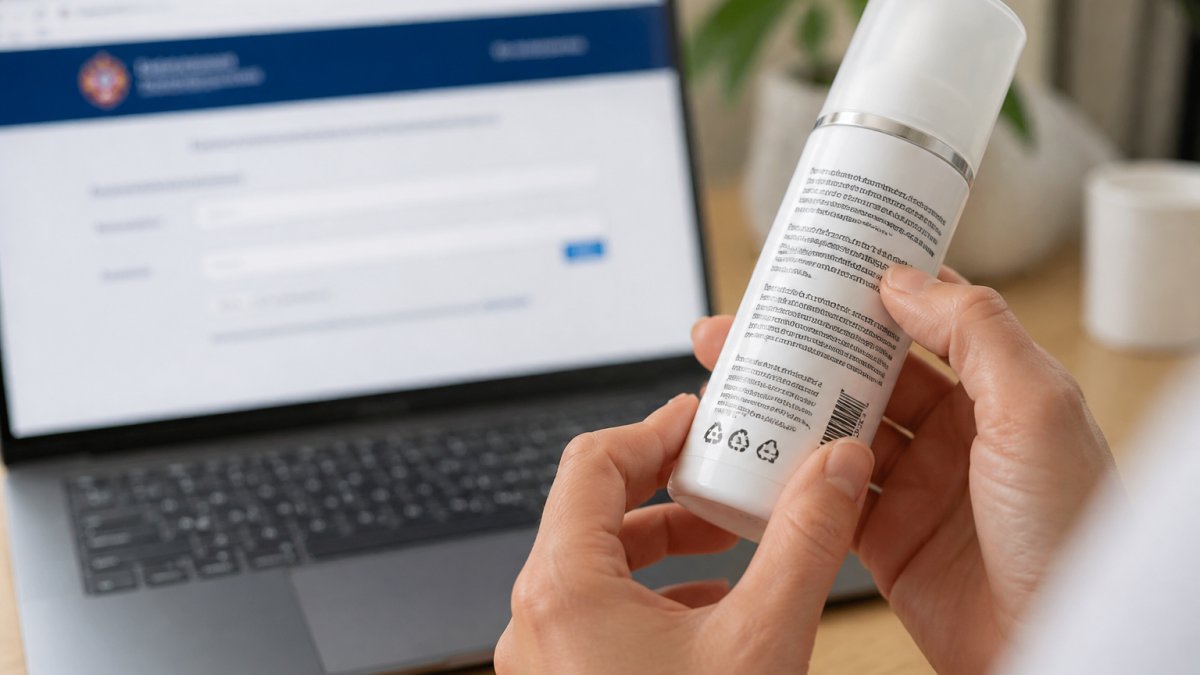
A match is only meaningful if the label and the record agree. Verify skincare product registration number details line by line, not just the name.
Check these against the portal:
- Product name and variant
- Brand owner and manufacturer
- Registration status and expiry date
Watch out: a record can be valid for a different pack size or variant than the one in your hand. A 30ml registration does not cover a 50ml bottle. If the details are close but not exact, that is a mismatch, and a red flag.
Step 4: Check Cosmetic Product Label Requirements UAE Rules Set Out
The label itself is evidence. A legitimate cosmetic product generally carries specific label information, and missing details are a warning sign before you even reach the database.
A compliant label should show:
- Product name and function
- Ingredient list
- Manufacturer or brand owner and address
If the ingredient list is absent, the batch code is missing, or the number is smudged beyond reading, stop. UAE cosmetic labelling guidance sets out what a label must carry.
Spotting expired, suspended or mismatched records
Three failures matter most. Expired means the registration lapsed. Suspended means the regulator pulled it. Mismatched means the record exists but does not match your pack. All three mean the same thing in practice: do not buy.
Step 5: Verify the Practitioner or Business Behind the Product
The last check is the seller. Even a registered product can be sold by an unlicensed operator, and a qualified practitioner is a separate credential from the product itself. Once the seller checks out, our simple guide to skincare shows how to build a routine around verified products. This is the step most buyers skip, and it decides whether the advice you are getting is authorized.
Three credentials, not one
A skincare provider can hold up to three separate authorizations, and each covers a different thing:
- Professional license, authorizes an individual to practice a specific health profession (for example, dermatology, aesthetic medicine, or cosmetic nursing). It names the practitioner and the scope.
- Facility license, authorizes the clinic, salon, or pharmacy premises to deliver specific services. A licensed practitioner working in an unlicensed facility is still a problem.
- Business/trade license, authorizes the commercial entity to sell health products. This is the one that matters when you are buying a product rather than receiving a treatment.
A common pattern is a practitioner with a valid professional license operating inside a facility whose license does not cover the service being offered. Checking only the person, or only the business, misses half the picture.
Matching identity, scope, and workplace
When you pull a practitioner record, compare four things against what you were told:
- Name, the licensed individual’s name should match the person treating or advising you. Nicknames and social-media handles are not identity.
- Profession and specialty, the scope on the license should cover the service. A general practitioner license does not authorize aesthetic injectables, and a cosmetic advisory role is not the same as a dermatology license.
- Facility, the workplace named on the license should match where the service is delivered.
- Status and validity, active, expired, suspended, or restricted. A restricted license may allow practice only under supervision or only for certain procedures.
Watch Out
A screenshot of a license is not verification. Screenshots are easy to edit, easy to reuse, and easy to borrow from another clinic. Always confirm the record on the official portal on the day you are checking, and note the date you checked.
A screenshot of a license is not verification. Screenshots are easy to edit, easy to reuse, and easy to borrow from another clinic. Always confirm the record on the official portal on the day you are checking, and note the date you checked.
Warning signs that survive a clean product check
- The practitioner cannot name their license number or the facility they are licensed at.
- The service is offered from a residential address, a hotel room, or a social-media account with no facility license shown.
- The license number returns a record for a different name, specialty, or workplace.
When a license cannot be found or details do not match
Ask the seller directly and wait for a clear answer. A legitimate operator will point you to their license number and the facility it is tied to. If the answer is vague, or the record shows a different name or scope, do not proceed.
Saha Jamal is a MoH-licensed website, license No. HAVU1MDZ-110326, so you can run this same check on us.
Frequently Asked Questions
Is a product registration number the same as a manufacturer’s licence?
No. A product registration number identifies a specific cosmetic formula that has been notified or registered with the Ministry of Health and Prevention. A manufacturer’s licence covers the facility where the product is made and confirms it meets good manufacturing practice. Both matter, but they answer different questions. When you verify MOH licensed skincare, check the product record against the label, then confirm the manufacturer and brand owner named on that record are licensed facilities rather than unknown third parties.
What should I do if I cannot find a skincare product in the official database?
First, re-check the spelling and format of the registration or notification number, since a single transposed digit returns no result. Confirm you are searching the cosmetics register rather than a medicine register. If the record still does not appear, treat the product as unverified and do not buy it. A missing record can mean the product was never notified, the registration lapsed, or the listing is counterfeit. Ask the seller for the certificate and the exact registered product name before proceeding.
Does a product being sold by a pharmacy prove that it is registered?
No. A pharmacy licence authorises the business to sell regulated health products. It does not automatically register every item on the shelf, and it does not cover products sold through a marketplace listing or a social media seller. Verify the product itself using its registration number and match the details to the label. If the seller cannot produce a registration record that matches the product name, brand owner and manufacturer, the pharmacy setting alone is not proof.
How can I tell whether skincare packaging or a registration number is counterfeit?
Compare the label against the official record field by field: product name, brand owner, manufacturer, ingredient list and registration number. Counterfeit listings often show a real number borrowed from another product, so a mismatch between the number and the product name is a strong warning sign. Check batch codes and expiry dates are printed cleanly and that the ingredient list matches the notified formula. Report suspected fakes to the Ministry of Health and Prevention.
Verifying every product should not feel like detective work. Saha Jamal takes that burden off your desk: we stock MoH-licensed skincare, haircare, and wellness products, charge a flat AED 15 shipping across the UAE, and deliver within 2-3 working days with 100% secured payments. Get started with Saha Jamal and shop verified skincare with confidence.